Hiking
Your rucksack: the 10 essentials for hiking in the mountains
Map, eye protection, insulation, first aid kit… A well-packed rucksack can make all the difference when things don't go to plan. Here are the 10 essentials to take with you in the mountains, even on a short walk.
Contents
Planning your next escape to the mountains? Whether you're an occasional weekend walker or a dedicated trail fanatic, what you carry in your pack makes all the difference. Up high, the weather can turn in the blink of an eye. Your rucksack is far more than just luggage: it's your all-terrain insurance.
Before you set off, remember this golden rule: your pack should never weigh more than 20% of your body weight. If you weigh 55 kg, aim for 11 kg at most. If you weigh 80 kg, you can carry up to 16 kg.
Choosing the right size
Type of outing | Capacity | Why? |
|---|---|---|
Day trip | 15 to 30 L | Light, for the essentials and your clothing |
2-3 days | 30 to 35 L | For technical equipment and a minimal bivouac |
Self-sufficient trip | 40 to 60 L | For the tent, stove and food supplies |
1. Navigation
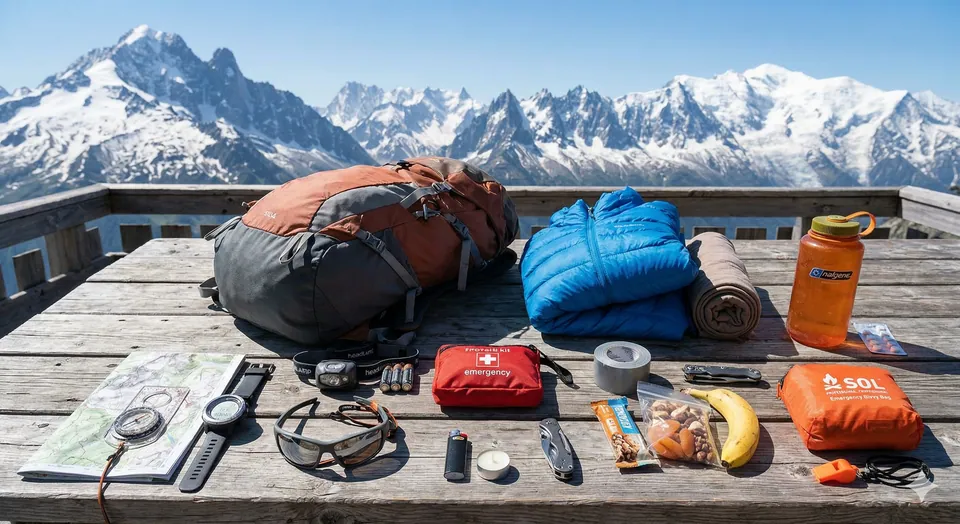
Don't rely solely on your phone: the cold drains batteries in no time! The real pros never head out without their winning trio: a good topographic map, a reliable compass and an altimeter.
💡 Expert tip: if you get into difficulty in the Alps with no phone signal, mountain rescue teams use VHF radio. The channel to remember: Channel E, on 161.300 MHz.
2. Eye Protection
At altitude, UV levels increase by 10 to 12% every 1,000 metres. Without suitable sunglasses, you risk snow blindness. Here are the categories to know about:
Category | Light transmission | Recommended use |
|---|---|---|
Category 0 | 80 to 100% | Very overcast conditions or night |
Category 1 | 43 to 80% | Hazy sky, winter in the valley |
Category 2 | 18 to 43% | Normal sunshine |
Category 3 | 8 to 17% | Summer mountain walking |
Category 4 | 3 to 8% | Mountaineering, glaciers, high altitude |
3. Insulation
Cotton is the enemy: once wet, it freezes and becomes dangerous. Stick to the three-layer system (breathable base layer, fleece, windproof shell) and always tuck a packable down jacket at the bottom of your pack – it will be a lifesaver during breaks.
4. Lighting
Night falls in the blink of an eye. Be prepared with a headtorch of at least 450 lumens and spare batteries – the cold drains them incredibly fast.
5. First Aid
Your first aid kit should stay light (around 250 g) but complete: blister treatment, antiseptic and, above all, anti-UV eye drops to protect your eyes at altitude.
6. Fire: the candle secret
As well as a lighter or a flint, pop a tea light candle in your pack. Placed under a survival blanket, it can add up to 8°C of perceived warmth – sometimes just enough to avoid hypothermia.
7. Repairs
A roll of duct tape and a multi-tool knife can literally save your walk. A sole coming unstuck, a rucksack strap giving way – with these, you're covered.
8. Nutrition
At altitude, your body burns calories at a rapid rate. Opt for rich, lightweight foods: dried fruit, energy bars and fast-acting sugars for sudden energy slumps.
9. Hydration
The dry mountain air dehydrates you without warning. Forget hydration bladders whose tubes freeze, and choose rigid water bottles instead. If you plan to drink from mountain streams, bring purification tablets.
10. Signalling and Shelter
A survival blanket (professional SOL model) and a pea-less whistle (to prevent freezing) are essential.
🆘 Universal distress signal: 6 short blasts on the whistle per minute.
In summary
A well-prepared pack is the key to a successful walk. These 10 essentials don't take up much room, but they can make all the difference if things go wrong. Always take five minutes to check the contents of your pack before setting off. The mountains are a magnificent playground, as long as you respect them.
Automatically translated from French.
Book your experience
 Nature discovery New
Chamonix-Mont-Blanc · Northern Alps
Discover the ecosystems of our mountains
From €53.90 / person